
What Is RTP in Slots? The 2026 UK Expert Guide

Table of Contents
If you have ever played an online slot and wondered why some games pay out more than others, the answer lies in RTP. RTP — Return to Player — is the single most important percentage to understand before you spin. This guide explains exactly what is RTP in slots, how it is calculated, what counts as a good RTP, and how UK regulations govern RTP disclosures at UK casinos.
What Is RTP in Slots? The Plain-English Explanation
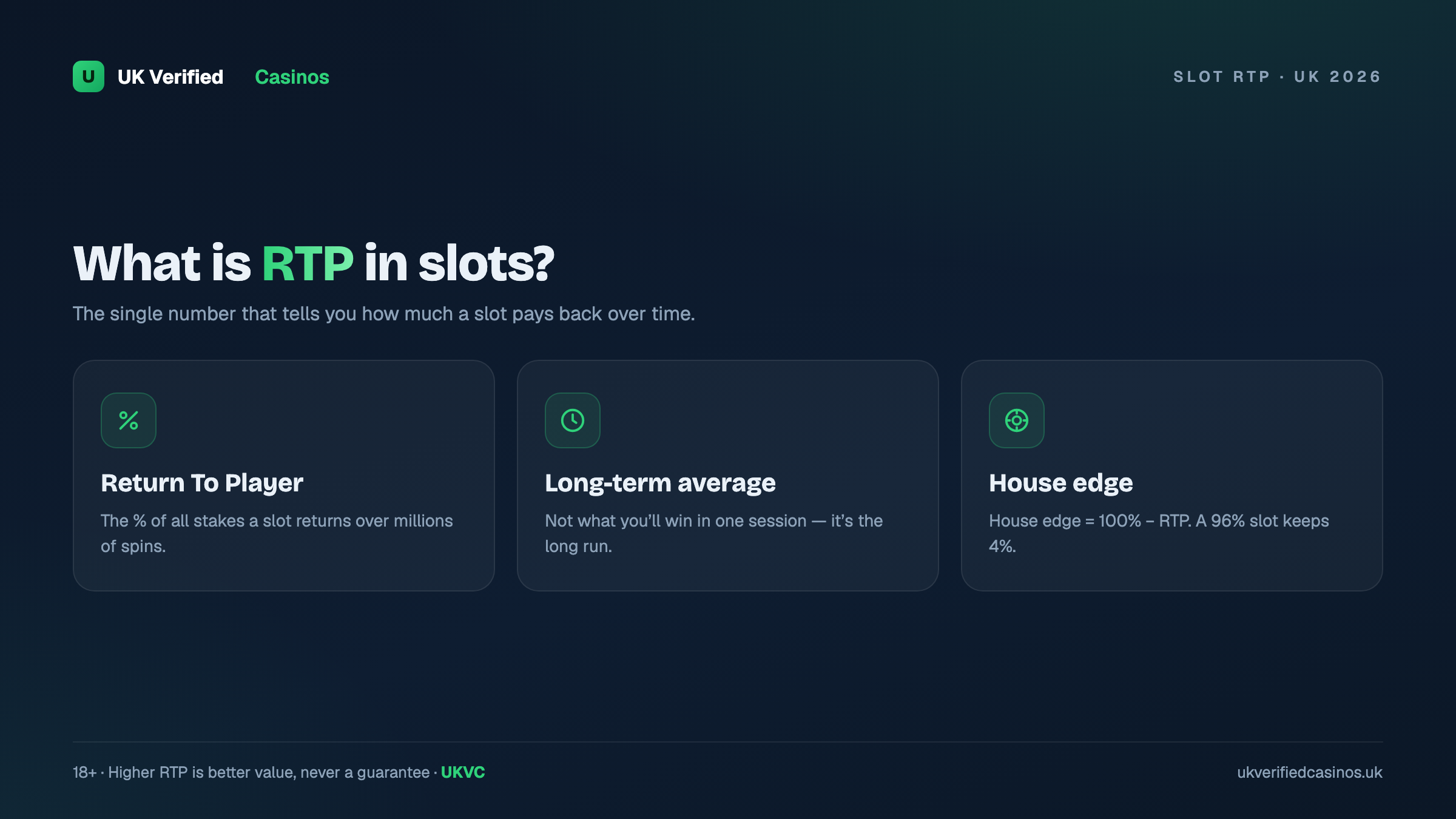
So, what is RTP in slots exactly? RTP — Return to Player — is a percentage representing how much of all money wagered on a slot is paid back to players over time. A slot with 96% RTP pays back £96 for every £100 wagered on average, across millions of spins. The remaining £4 represents the house edge.
What is RTP in slots does not mean you personally receive 96p back for every £1 you stake. RTP is a theoretical long-term average calculated over vast numbers of rounds — not a guarantee for any single session. One player may hit a jackpot while another loses their full deposit on the same game.
Understanding what is RTP in slots is essential for any UK player wanting to make informed choices. It is the baseline measure of how much a slot returns to players collectively, and it is the figure the UK Gambling Commission (UKGC) requires every licensed casino to disclose for every game in their library. You can read more about this topic on Wikipedia’s online casino article.
How RTP Is Calculated
Game developers calculate RTP by running simulations across billions of virtual spins. The resulting percentage is certified by an independent testing laboratory before the game is released. The figure is then locked into the game’s software — neither the casino nor the player can alter it during play.
Some providers release multiple RTP versions of the same slot — for example, a 94% variant and a 96% variant. Under UKGC rules, UK casinos must display the RTP of the specific version actually deployed on their platform, not just the highest possible figure. Always check this before you spin.
RTP vs. House Edge— What Is the Difference?
RTP and house edge are two sides of the same coin. Once you know what is RTP in slots, calculating the house edge is straightforward: simply subtract the RTP from 100.
- A slot with 96% RTP carries a 4% house edge
- A slot with 94% RTP carries a 6% house edge
- A slot with 97% RTP carries a 3% house edge
The higher the RTP, the lower the house edge. When comparing two otherwise identical slots, the higher-RTP game will statistically return more money to players collectively over millions of rounds. This is precisely why knowing what is RTP in slots helps you pick better games and stretch your bankroll further.
What Is a Good RTP for an Online Slot?
For UK online slots, here is how to judge RTP values:
- 96% and above — Excellent. Most major online slots from providers such as NetEnt, Microgaming, and Pragmatic Play target this range.
- 94%–96% — Average. Acceptable, but higher-RTP alternatives are usually available.
- Below 94% — Poor. Seek out higher-RTP alternatives before committing your bankroll.
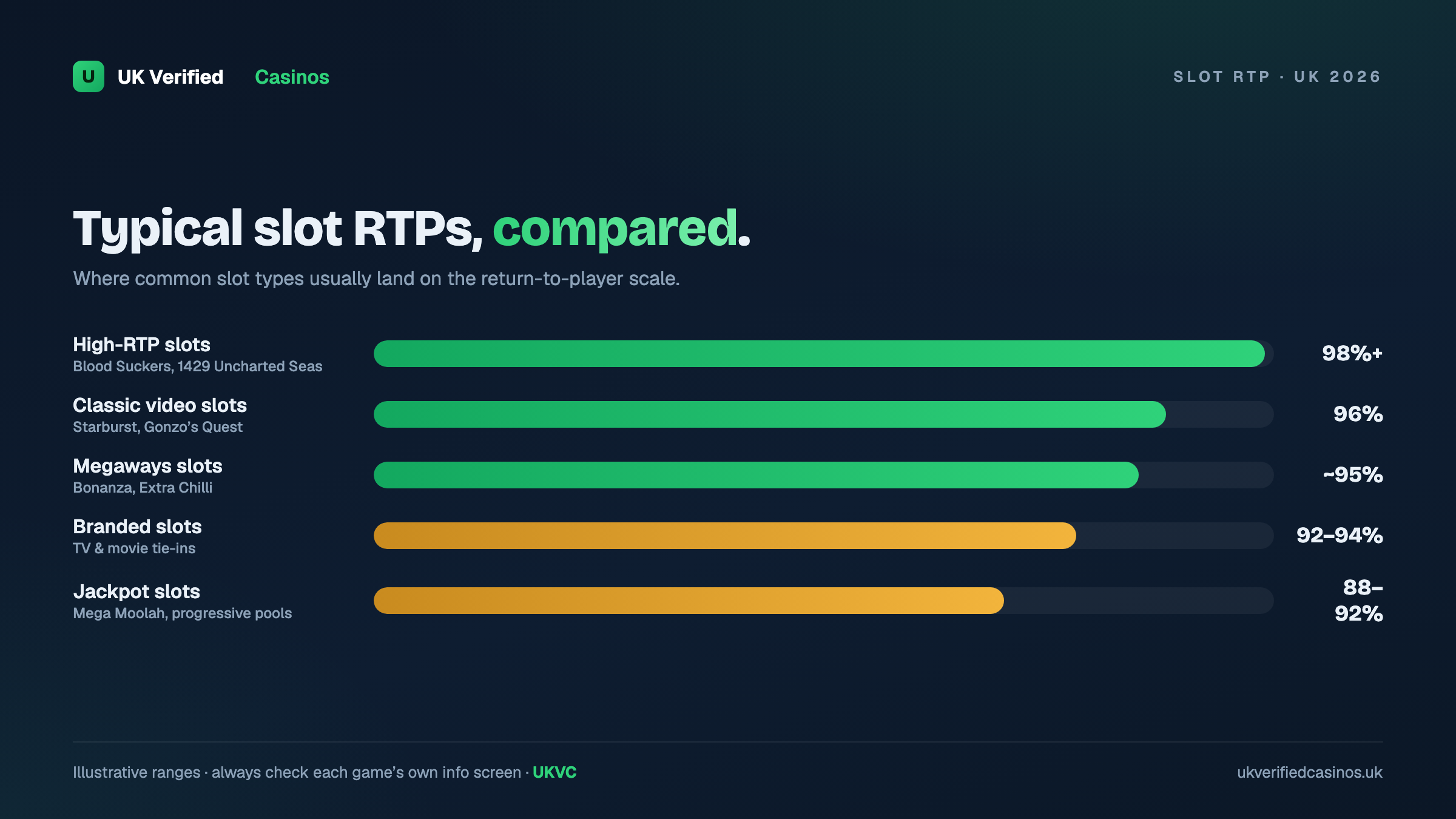
Some of the highest RTP slots available at UK casinos include Mega Joker (99%), Goblin’s Cave (99.32%), and Blood Suckers (98%). However, high-RTP slots sometimes carry lower volatility, producing smaller but more frequent wins rather than large jackpot potential. See our free spins UK casinos guide to find sites where you can trial slots at low cost.
What Is RTP in Slots vs. Volatility?
RTP alone does not tell the full story. Alongside understanding what is RTP in slots, you need to grasp volatility — the measure of how frequently a slot pays and how large those payouts tend to be.
- Low volatility slots — pay frequently but in smaller amounts. Well suited to longer sessions on a limited budget.
- High volatility slots — pay less frequently but can deliver much larger individual wins. Results can swing wildly from the RTP figure within a single session.
- Medium volatility slots — balance frequent smaller wins with occasional larger payouts.
A high-RTP, high-volatility slot may return 97% to players over millions of spins. However, in a 100-spin session, you could easily exhaust your stake or win a large multiple of it. Combining your knowledge of what is RTP in slots with volatility awareness helps you choose games that match your bankroll and play style.
Does RTP Change With Bonus Play?
RTP does not technically change when you play with a bonus — the game’s mathematical return is fixed by its software. However, wagering requirements affect the effective value of a bonus. Under UK casino regulations 2026, wagering requirements are capped at 10x.
Playing a 96% RTP slot through a 10x wagering requirement means you are expected to retain roughly £66 of every £100 bonus after completing the wagering — a considerably better outcome than older 40x requirements. Explore our guide to best casino bonuses UK to find the most player-friendly offers currently available. For no-cost trials, our no deposit bonus UK page lists current deals.
RTP Ranges Compared: 7 Slot Examples
The table below illustrates the range of RTP figures you will encounter at UK online casinos. Use it alongside our how to choose a UK online casino guide to narrow down your options.
| Slot Title | Provider | RTP | Volatility | RTP Rating |
|---|---|---|---|---|
| Goblin’s Cave | Playtech | 99.32% | Low | Excellent |
| Mega Joker | NetEnt | 99.00% | Low–Medium | Excellent |
| Blood Suckers | NetEnt | 98.00% | Low | Excellent |
| Starburst | NetEnt | 96.09% | Low | Excellent |
| Sweet Bonanza | Pragmatic Play | 96.48% | High | Excellent |
| Book of Dead | Play’n GO | 94.25% | High | Average |
| Generic Low-RTP Slot | Various | Below 94% | Varies | Poor — avoid |
What Is RTP in Slots Under UKGC Disclosure Rules?
The UKGC requires all licensed online casinos to make RTP information readily available to players. Under our UK casino regulations 2026 guide, casinos must display the theoretical RTP for every game in their library. For slots with configurable RTPs, the casino must show the RTP of the actual version deployed — not just the maximum possible figure.
Browse our full casino listings — including Spin Formula, Spartaza and 7Gear — to compare how each site displays RTP information.
For players who enjoy real-time gameplay, our live casino UK guide explains how RTP applies to live dealer games, which operate differently from fixed-RNG slots. For faster access to winnings, see our fast withdrawal casinos UK page.
Responsible Gambling: RTP is an educational tool — it is not a strategy for profit. Gambling should always be enjoyed as entertainment within a budget you can afford to lose. If you feel your gambling is becoming harmful, please visit GamStop to self-exclude from all UKGC-licensed sites instantly. Additional support is available via our responsible gambling UK guide.
Frequently Asked Questions
Q: What is RTP in slots, in simple terms?
A: What is RTP in slots stands for Return to Player — a percentage showing how much of all money wagered on a slot is paid back to players over millions of spins. A 96% RTP means £96 is returned for every £100 wagered on average across the game’s lifetime. It is a theoretical figure, not a personal session guarantee.
Q: What is RTP in slots and how does it differ from house edge?
A: They are the same metric expressed differently. What is RTP in slots shows the player’s share (e.g., 96%), while house edge shows the casino’s share (e.g., 4%). Add the two together and you always reach 100%. The higher the RTP, the lower the casino’s mathematical advantage.
Q: What is RTP in slots considered good for UK players?
A: For UK online slots, 96% and above is considered excellent. The range 94%–96% is average, and below 94% is poor. Notable high-RTP examples include Goblin’s Cave at 99.32%, Mega Joker at 99%, and Blood Suckers at 98%. Always check the specific RTP configured at your chosen casino.
Q: What is RTP in slots when playing with a bonus?
A: What is RTP in slots does not change when you use a bonus — the game’s mathematical return is fixed by its software. However, wagering requirements reduce the effective value of bonus funds. Under UK 2026 regulations, wagering is capped at 10x. Playing a 96% RTP slot through a 10x requirement means you can expect to retain roughly £66 of every £100 bonus after wagering.
Q: Does what is RTP in slots apply to live casino games?
A: Live dealer games also have published return percentages, but they are calculated differently from slot RTP. Blackjack and roulette use known mathematical probabilities rather than RNG-based simulations. Slot RTP is specific to fixed-reel or video-slot mechanics — it does not directly translate to table games.
Q: Where can I check what is RTP in slots before I play?
A: All UKGC-licensed casinos must display RTP in the game information or paytable for every slot. You can also find RTP figures on the game developer’s official website.
Q: What is RTP in slots and how does volatility affect my choice?
A: RTP tells you the long-term return percentage; volatility tells you how that return is distributed. A high-RTP, low-volatility slot delivers frequent small wins close to the RTP average. A high-RTP, high-volatility slot can swing dramatically in any single session despite the same theoretical return. Combining both metrics gives the clearest picture of what to expect.
Understanding what is RTP in slots is the foundation of smart slot play. Always target 96%+ RTP, factor in volatility, check the actual RTP configured at your casino, and remember it is a long-term theoretical average — not a session promise. If gambling ever stops feeling fun, please use GamStop to self-exclude immediately.